
💡 Key Takeaways
- Statistical Significance: How to properly evaluate A/B test results.
- Practical Case Studies: Real examples of successful tests across different industries.
- Methodology: Step-by-step algorithm for conducting professional tests.
- ROI Metrics: How to measure test impact on business performance.
A/B Testing: From Hypotheses to Measurable Results
A/B testing is not just about comparing two page variants. It's a systematic approach to conversion optimization based on data, not assumptions. In today's competitive landscape with rising traffic costs, every percentage point of conversion directly impacts your bottom line.
ClikBy transforms A/B testing from a complex technical process into an intuitive tool accessible to any marketer. The system automatically distributes traffic, collects statistics, and provides data for making informed decisions.
A/B Testing Methodology
Successful A/B testing requires a systematic approach. Every stage of the process is critical for obtaining reliable results.
Test Planning and Preparation
Hypothesis Formulation
Clearly define exactly what you're testing and what results you expect. Your hypothesis must be measurable and based on user behavior data.
Success Metric Selection
Define your primary metric (conversion rate, CTR, time on site) and secondary indicators that will help assess the business impact of your changes.
Sample Size Calculation
Determine the minimum number of test participants needed to achieve statistically significant results. Consider your current conversion rate and expected effect size.
Test Variant Creation
Develop your control (A) and test (B) variants. Change only one element at a time to clearly understand what's driving the results.
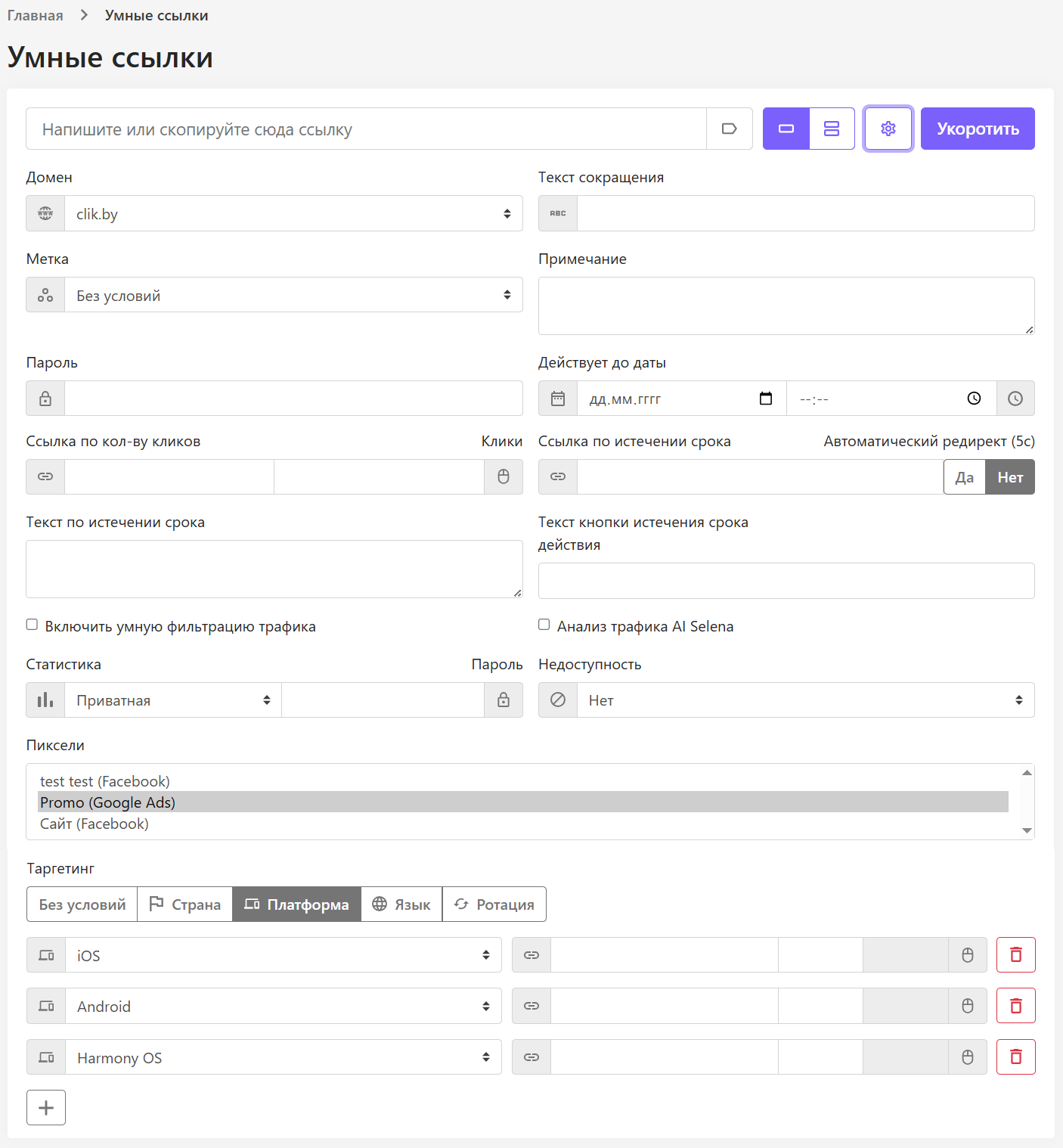
Test Setup in ClikBy
ClikBy offers three levels of A/B testing complexity, each designed to address specific marketing challenges:

Important: Before launching your test, verify that all variants are properly configured and lead to the correct pages. Run a preliminary check with a small amount of traffic.
Results Analysis and Interpretation
Proper interpretation of A/B test results is a crucial marketing skill. Simply comparing conversion numbers isn't enough.
Statistical Significance Verification
Results are considered reliable at a 95% confidence level (p-value < 0.05).
Practical Significance Assessment
A statistically significant result may lack practical significance. Calculate revenue impact: a 0.1% conversion increase could generate thousands in additional profit.
Segment Analysis
Examine results across different audience segments. The change might only work for specific user groups (new/returning, mobile/desktop).
Practical Case Studies of Successful A/B Tests
Let's examine real A/B testing examples across various industries with detailed methodology and results analysis.
E-commerce and Online Retail
Testing Purchase Incentives
Electronics E-commerce Store
Hypothesis and Setup
The online store hypothesized that a personalized "Free Shipping" offer would outperform a generic "15% Discount."
ClikBy Setup: Created a single smart link with 50/50 rotation between two landing pages with different offers.
Testing Period: 14 days, 5,000 unique visitors.
Results and Analysis
Conclusion: The free shipping offer demonstrated statistically significant superiority. Further analysis revealed the effect was especially strong for orders above $50.
Mobile Conversion Optimization
Fashion Retailer
Problem and Solution
Mobile conversion was 40% lower than desktop. Hypothesis: simplifying the checkout process will increase conversion.
ClikBy Setup: Created a single smart link with 50/50 rotation between two different checkout forms on the website.
Test Variants:
- Control: standard checkout form (4 steps)
- Test: simplified form (2 steps) + express payment
Measured Metrics
Business Impact: Mobile revenue increased by $4,500 per month with no change in acquisition costs.
Content & Media
Article Headline Optimization
News Portal
Testing Methodology
The portal tested the impact of emotional headline framing on CTR in social media and email campaigns.
ClikBy Setup: Created two smart links to get detailed analytics for each headline variant.
Headline Variants:
- A: "5 Ways to Reduce Your Utility Bills"
- B: "How I Saved $250 on Utilities This Year"
Results by Channel
Insight: Personal stories with specific numbers significantly outperform abstract tips.
SaaS & B2B Segment
Trial Period Testing
CRM System for Small Business
Testing Strategy
The company tested how free trial length impacted conversion to paid subscription.
ClikBy Setup: Created a single smart link with 50/50 rotation between two landing pages with different offers.
Test Variants:
- Control: 14-day free trial
- Test: 30-day free trial
Long-term Results
Unexpected Insight: The longer trial period not only increased conversions but also improved retention—users who tried the product for 30 days stayed as customers longer.
Key Metrics & Evaluation Methods
Professional A/B test evaluation requires understanding different metrics and their relationship to business goals.
Primary Metrics
- Conversion Rate (CR) — the primary metric for most tests
- Click-Through Rate (CTR) — for testing creatives and headlines
- Average Order Value (AOV) — for e-commerce projects
- Cost Per Acquisition (CPA) — for evaluating funnel efficiency
Business Metrics
- Revenue Per Visitor (RPV) — comprehensive metric of revenue impact
- Customer Lifetime Value (LTV) — long-term customer value
- Return on Ad Spend (ROAS) — advertising investment ROI
Pro Tip: Always evaluate both statistical and practical significance. A 0.1% conversion increase may be statistically significant but have no meaningful business impact.
Conclusion & Recommendations
A/B testing in ClikBy isn't just a tool for comparing variants—it's a comprehensive system for optimizing marketing processes. Proper methodology enables you to:
- Make data-driven decisions, not assumption-based ones
- Systematically improve conversions at every funnel stage
- Reduce risks when implementing changes
- Maximize ROI of marketing activities
Core Principle: Every test must have a clear hypothesis, sufficient sample size, and proper result interpretation. Only then does A/B testing become a true growth driver for your business.